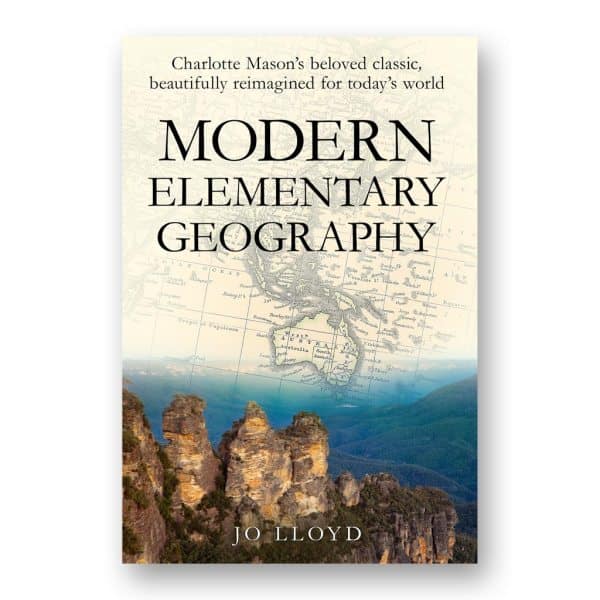
Modern Elementary Geography brings a beloved Charlotte Mason classic into today’s world. Families will love its warmth and clarity and appreciate the range of themes and topics covered, which span aspects of physical and social geography.
In the 150 years since Charlotte Mason first penned Elementary Geography a lot has changed in the field of Geography. While space exploration has helped us to better understand our universe, the places and lands she once described have grown and developed in different ways. Computer technology has changed the way we collect and process information and today geographers can use a digital map on a smartphone, examine a 3D map of the seafloor, or view satellite images from around the world. Our understanding of the world has evolved, and a modern approach to geography needs to cover new themes and topics, including our oceans and waterways, megacities, GPS and GIS, climatic zones, and much more. Modern Elementary Geography retains the same warmth and rigor of the original but brings it into the modern world.
Please share a little about you and your family.
My husband Cliff and I live in regional New South Wales (NSW), in Australia, not too far from our national capital, Canberra. We have three children. Our eldest son is studying at the Australian National University and our younger two – Dominic and Ingrid – are still being homeschooled. We’ve now been home educating for over 15 years, following the Charlotte Mason method. As a cross-cultural family, I love creating resources to help other homeschoolers, especially those in the Asia-Pacific region.
I’m involved in various aspects of homeschooling, including serving on the NSW Home Schooling Consultative Group and supporting curriculum reform. I have presented to homeschooling inspectors and Authorised Persons, and in 2025 I was invited to share my homeschooling experience as a part of the NSW Performance Audit. I’ve contributed to Common Place Quarterly and Charlotte Mason Poetry and share at homeschooling conferences, workshops, and on podcasts. I also host the Asia-Pacific group for the Charlotte Mason Poetry Idyll Challenge. It is a delight to read Charlotte’s volumes together.
Why did you write Modern Elementary Geography?
When I was in high school my mum suggested I choose Geography as one of my electives. She had loved learning about people and places as a student. I enjoyed it so much that I continued to study Geography at university alongside my Law degree. Cliff studied Geography too, as part of a degree in Science. Growing up in Asia and on Christmas Island in the Indian Ocean inspired his interest. So, naturally when we started homeschooling we were both looking forward to sharing our love for this subject with our children.
However, when I picked up Elementary Geography by Charlotte Mason while I could see her love for Geography, I couldn’t deny how much was outdated. I knew there was so much more that should be shared and taught. At the same time, so many families told me how they found Geography boring. So, I decided that creating a modern edition would help others too.
Who is this book for? What does it cover?
Modern Elementary Geography explores our world, in our its beauty and wonder. Itis for every family wanting to teach Geography well, no matter where they live. Families trialling the book commented that they loved it for their children in primary (elementary) school but that their high schoolers benefited from the contemporary approach to Geography too. Many loved it as a family read aloud.
The book covers a range of physical and social Geography topics, suitable for various ages and grades. It explains Earth’s place in space and the solstices and equinoxes. The five oceans and seven continents are examined, along with various landforms and landscapes. Students learn about water in the landscape, modern map making, as well as cities and towns, and much more.
Questions and answers are provided for each chapter, including map questions. It includes the same number of chapters as Charlotte’s original work and features poetry too, but showcases a range of voices and perspectives.
All this makes Modern Elementary Geography the perfect place to begin learning about Geography.
What is your favourite part of the book?
I really love the Epilogue. Although placed at the end, it circles back to the inspiration of why I wanted to write the book in the first place. It captures many of the exciting and important developments that have contributed to an increased understanding of our world.
My kids love that I included geocaching and Pokémon Go in the book.
I will say that working with Anthony was one of my favourite parts of writing the book. He made it a delight to create and had the most beautiful cover crafted, including my one specific request for the “You Are Here” pin on the spine. I love it! It is a pleasure to work with someone keen to share Charlotte’s approach in the modern world.
(Spoiler: We have more books coming and they are looking great!)
What is your top tip for teaching Geography?
Stories matter. Geography comes alive when you connect students to places and people, when you examine a map and explain what the land there is really like. This isn’t about dry facts, but about other places and people in our world and learning how they live. Geography is a tool for understanding, not just things to memorise.
Where can people find out more?
Please head over to Living Book Press to learn more about Modern Elementary Geography. The lovely team there are ready to help with any questions you may have.
To find out what else I’m up to you can head to www.livingeducation.com.au or pop onto Instagram. This is where I share snippets of our homeschooling life, including how we teach Geography: https://www.instagram.com/graceclaritywisdom